
Months before the Space Shuttle Challenger disaster, engineers at Morton Thiokol documented severe concerns about the rubber O-rings failing in freezing temperatures. They were technically "accountable" for the hardware, but NASA's internal culture had drifted into a space where speaking up was dangerous.
The night before the launch, engineer Roger Boisjoly pleaded with managers to scrub the mission. Instead of listening, a senior manager told his team to "take off your engineering hats and put on your management hats". The message was clear: schedule mattered more than safety, and dissenting data was unwelcome. The warning stayed in the parking lot of internal memos, resulting in a catastrophic, avoidable failure.
Years later, an identical cultural failure caused the Space Shuttle Columbia disaster. Engineer Rodney Rocha spotted a critical foam strike but stayed silent during a management meeting because he felt he was "too low down" in the organization to speak up.
Now, let's bring this back to your world.
In the fire service, you rely heavily on standard operating procedures (SOPs) on the fireground. But back at the station—where your department’s culture is actually built—your real "SOPs" are often completely unwritten.
If your crews' best ideas and hardest truths stay at the kitchen table or in the parking lot after the Chief leaves the room, your department is operating with a latent defect. It’s a quiet flaw, but it will eventually manifest on the fireground when the stakes are highest. For Command Staff, understanding psychological safety isn't a soft leadership trend; it is a life-saving operational imperative.
Redefining the Terms: It's Not About "Lowering the Bar"
Let’s address a common misconception right away: psychological safety is not a trade-off with accountability. Some leaders assume that fostering a safe, supportive environment means putting less pressure on personnel to meet standards.
Psychological safety is not about "lowering the bar" or simply being nice; it is the essential floor that allows elite standards to exist without crushing your organization.
Harvard professor Amy Edmondson defines psychological safety as the cultural belief that you will not be punished or humiliated for speaking up with ideas, questions, concerns, or mistakes. It is the freedom to take interpersonal risks, knowing candor is expected.
Accountability, conversely, is the proactive commitment to take ownership of your actions and outcomes before, during, and after a task. True accountability shifts from something done to someone, to something done with them.
As a mentor to your officers, which type of accountability are you cultivating?
Punitive Accountability: Rooted in a fixed mindset, relying on fear of punishment and demanding perfection rather than growth.
Growth-Oriented Accountability: An empowering sense of ownership where individuals learn from failures, anticipate obstacles, and actively seek feedback.
What the Data Tells Us
When people are afraid to bring bad news to the table, an organization isn't tough—it's blind. Consider these findings as you reflect on your own team:
The Culture of Silence: One workplace study found that 85% of respondents had stayed silent about a critical concern because they felt unable to raise it with their bosses.
The Secret of High Performance: Google’s massive internal study, Project Aristotle, concluded that psychological safety was the single most important factor differentiating high-performing teams from less effective ones.
Fewer Errors, Open Communication: A study of high-stakes healthcare environments showed that psychologically safe nursing teams actually made fewer errors and spoke up about them more often.
Unlocking Potential: Employees who feel heard are 4.6 times more likely to perform their best work.
Map Your Culture: The 4 Zones
To help your officers chart a path forward, it helps to evaluate where your shifts or stations currently sit by mapping psychological safety against accountability.
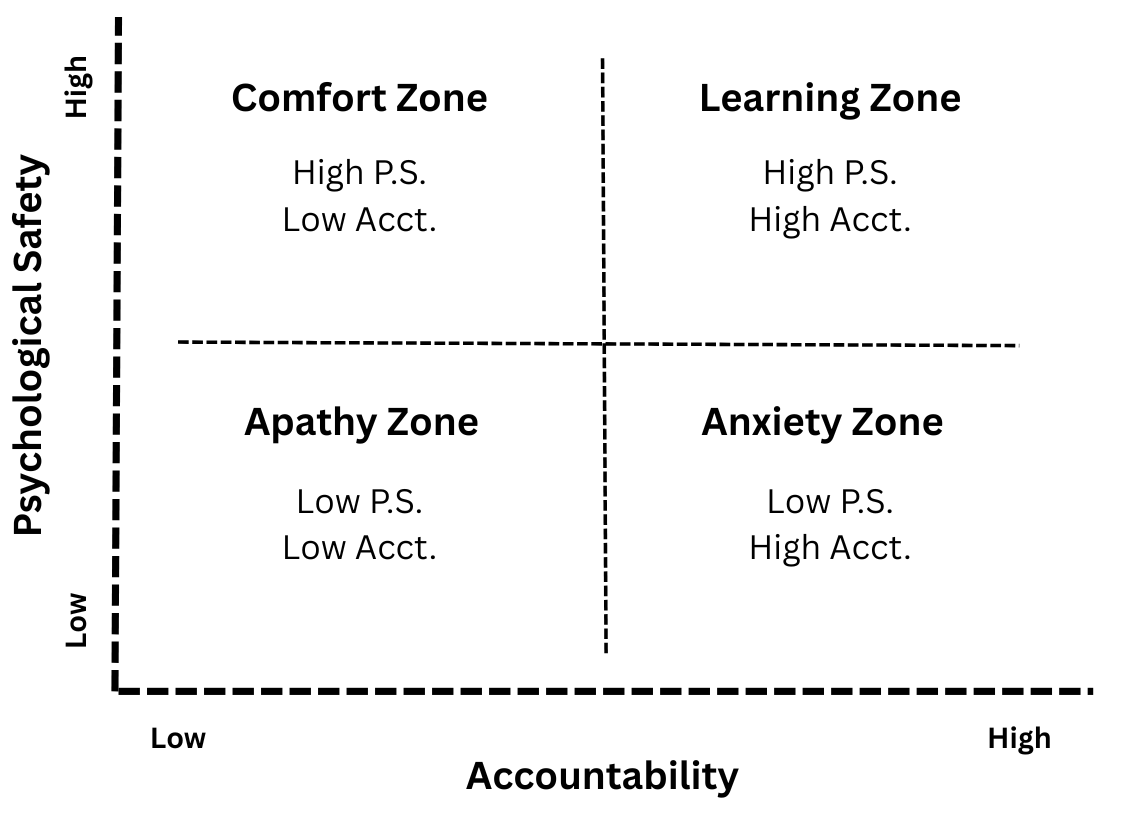
The Apathy Zone (Low Safety, Low Accountability): Personnel show up, do the bare minimum, and go through the motions. Neither safety nor performance is genuinely pursued.
The Comfort Zone (High Safety, Low Accountability): People are friendly and comfortable, but nobody challenges themselves or their peers. Substandard performance is ignored just to keep the peace.
The Anxiety Zone (Low Safety, High Accountability): This is where many traditional, hierarchical fire departments get trapped. Standards are high, but fear of punitive consequences is rampant. Crew members hide mistakes, near-miss data is lost, and "parking lot talk" thrives.
The Learning / High-Performance Zone (High Safety, High Accountability): The ultimate goal for Command Staff. We hold incredibly high standards, but we make it inherently safe to admit when we fall short so we can course-correct together.
Guiding Your Team Through the 4 Stages
Moving your team into the Learning Zone requires intentionally guiding them through four progressive stages of safety:
Stage 1: Inclusion Safety: Every member feels accepted and valued for who they are, without status symbols or cliques.
Stage 2: Learner Safety: Members feel confident to ask questions, experiment, and admit mistakes. Leaders model this by openly sharing their own learning moments.
Stage 3: Contributor Safety: Individuals feel empowered to take ownership of their work, offer solutions, and engage in all-directions feedback.
Stage 4: Challenger Safety: The pinnacle. Members are encouraged to question assumptions and share dissenting views without fear of retaliation, protecting the team from dangerous groupthink during complex incidents.
The Three Pillars for Command Staff
How do you mentor your officers to build this culture at a busy fire station? Focus on three actionable leadership pillars:
Pillar 1: Set the Stage (Reframe the Work)
Shift your mindset—and help your officers shift theirs—from "I am the Chief who has all the answers" to "I am the Chief who ensures we find the right answer". Acknowledge the extreme complexity of modern emergency services. Tell your leaders directly: "I can't see everything from my office; I need your eyes on the ground to keep this department healthy".
Destigmatize failure by separating preventable failures (deviating from established procedures) from intelligent failures (thoughtful exploration into new territory). Frame the work as a complex learning problem rather than a simple execution exercise.
Pillar 2: Invite Participation (Practice Humility)
Don’t just wait for your crew to speak up; create the vacuum that forces them to fill it. Practice situational humility by recognizing you don’t have a crystal ball.
Instead of ending a briefing with "Does anyone have questions?"—which usually results in dead silence—use Powerful Inquiry. Ask targeted, reflective questions like:
"What is the one thing I'm missing that is going to make this plan fail?"
"What are they saying in the parking lot that I haven't heard yet?"
Pillar 3: Respond Productively
Your very first response to an interpersonal risk dictates whether your people will ever take one again. When someone brings a problem or admits a mistake, start with appreciation: "Thank you for having the courage to bring that to me". Only after rewarding the courage to speak do you pivot into proactive problem-solving.
Replace the accusatory "Who did this?" with the systemic "What happened?". Practice Radical Candor—caring personally while challenging directly. Finally, remember that accountability still requires sanctioning clear, repeated violations of core values; holding reckless behavior accountable actually reinforces psychological safety for the rest of the team.
Conclusion: The Accountability Contract
High psychological safety does not dilute accountability; it maximizes it by completely removing the excuses for silence. In a truly fearless organization, looking the other way becomes the only true sin. You cannot hold someone accountable for an elite standard they are inherently afraid to discuss, which makes psychological safety the primary engine for any sustainable culture of excellence in the fire service.
Reflection and Self-Assessment for Command Staff
To move this from theory into action, use these questions to reflect on your own leadership style and station culture:
Eavesdropping on the Kitchen Table: If you could overhear the conversation after you leave the room, which of the four zones (Apathy, Comfort, Anxiety, Learning) would your crew say they are genuinely in? What is your actual evidence for that?
The Cost of Silence: Think of a time a junior member didn't speak up about a "small" issue that eventually snowballed into an administrative crisis. What was the operational "tax" paid for that silence?
Modeling Vulnerability: How often do you consciously acknowledge your own fallibility and share past mistakes with your officers to give them permission to do the same?
Ownership vs. Blame: When an operational failure occurs on a shift, does your leadership circle default to extreme ownership, or does the culture lean toward blame-shifting?
The "One Thing" Challenge: In the next 48 hours, identify one crucial conversation that has been relegated to the parking lot. Approach that person and say: "I realize I haven't made it easy to talk about [X] in the station. I want to change that. What do I need to know?"
