
Putting Out Fires All Day (So You Never Fight the Right One): A Command Staff's Guide to Prioritization
At 02:17, a working fire changes direction.
A company reports deteriorating conditions. A second alarm is being considered. Someone needs a staffing decision. A family member is asking for information. Your phone is vibrating with messages about tomorrow’s schedule.
Every issue feels urgent. Every person wants an answer. Yet you know that reacting to the loudest request is not the same as leading.
In my work with Command Staff, overwhelm is one of the most common pain points I hear about. It is real. Whether you are a Captain, Battalion Chief, Assistant Chief, or Chief, your to-do list can become longer than the day itself. Interruptions arrive constantly. Your people need access to you. Your organization needs thoughtful decisions. And somewhere between the radio traffic, emails, meetings, and personnel concerns, the work that matters most can get pushed to tomorrow.
Then tomorrow brings another list.
The solution is not to become unavailable or to work longer hours. The solution is to lead with clearer priorities.
The Command Staff Trap: Treating Every Task Like a Fire
On the fireground, you do not treat every problem the same. You assess risk, set priorities, assign resources, and communicate intent.
Your leadership work deserves the same discipline.
The National Wildfire Coordinating Group’s incident command guidance emphasizes clear objectives, strategies, and tactics. Apply that same lens to your calendar:
What carries the greatest consequence if ignored?
What truly requires my attention today?
What can be delegated, scheduled, or eliminated?
Which decision prevents future problems instead of just quieting today’s noise?
If you do not establish priorities, every interruption becomes the incident commander.
A Practical Framework: Fires, Foundations, and Noise
A long list does not tell you what matters. It only tells you what you captured.
1. Fires: Urgent and consequential
These are issues where delay creates immediate risk or operational impact, such as:
Firefighter safety concerns
Escalating incidents
Critical staffing gaps
Serious personnel or conduct issues
Compliance, funding, or public safety deadlines
Decisions blocking multiple people or operations
Ask: What is the consequence of waiting?
2. Foundations: Important but not urgent
Foundations are the work that builds readiness, trust, and long-term performance:
Coaching officers
Building relationships with crews
Reviewing near misses and lessons learned
Improving culture
Planning training
Preparing future leaders
Having hard conversations early
Fixing systems that create repeat problems
These items rarely shout for attention, which is why they get postponed. But when ignored, they often return as fires: conflict, low trust, weak accountability, and avoidable turnover.
What foundation have you been postponing because something louder keeps appearing?
3. Noise: Neither urgent nor important
Noise consumes attention without moving safety, service, people, or strategy forward. Common examples:
Meetings without a clear purpose
Rechecking delegated work
Responding instantly to every message
Solving problems that belong to someone else
Continuing low-value projects out of habit
Your job is not to dismiss people. Your job is to place each issue in the right lane.
Interruptions: The Difference Between Access and Availability
An open-door culture does not mean every issue deserves immediate access to your attention.
Trust requires access. Effective leadership requires boundaries.
Set clear standards:
Interrupt me immediately when:
Someone’s safety may be at risk
An incident is escalating
A critical staffing or operational issue needs a decision
A serious personnel concern cannot wait
The issue may create major legal, ethical, or reputational consequences
Capture and schedule issues when:
The matter is important but not time-sensitive
More information is needed
The issue belongs in a one-on-one conversation
Someone needs coaching, not an instant answer
The request can be delegated or handled during a check-in
Use scripts like:
“I want to give this the attention it deserves. I cannot do that well in the next five minutes. Let’s meet at 1400.”
“Thank you for bringing this to me. Is anyone’s safety or the operation at immediate risk? If not, I’m going to capture it and we’ll decide on the next step during our check-in.”
You are not rejecting the person. You are protecting the quality of your response.
Trust Is Not the Opposite of Productivity
Many leaders worry that boundaries will make them seem unapproachable. Usually, the opposite is true.
People trust leaders who are clear, consistent, and reliable. They do not need you to say yes to everything. They need to know you will follow through.
A rushed half-answer may look like access, but it rarely builds confidence. A focused conversation at the right time often builds more trust.
The fire service guidance on mission command points to trust, competence, intent, and disciplined initiative. That applies in the station too.
Use interruptions to practice emotional intelligence:
Self-awareness: Notice if you are tired, rushed, or overloaded.
Self-management: Pause before responding.
Social awareness: Listen for what the person is really bringing you.
Relationship management: Clarify the next step and follow through.
Try this:
“I hear that this has been frustrating. Before we decide what to do, help me understand what happened and what outcome you believe would improve the situation.”
For more on this connection, I invite you to explore my articles on emotional intelligence in the fire service and psychological safety and accountability.
Mental Fitness: Notice Which Brain Is Running the Command Post
When your list feels overwhelming, your mind can default to short-term survival mode. You answer the newest message, chase the loudest complaint, and move from interruption to interruption.
You are busy: but are you leading?
In mental fitness work, this reactive pattern is often called the “Saboteur” brain. Your “Wise Mind” creates space to assess and choose intentionally.
Before reacting, take a brief reset:
Stop
Take one slow breath
Name the issue
Identify the consequence of delay
Decide: respond, delegate, schedule, or release
Ask yourself:
Am I responding because this is truly important, or because it is uncomfortable to leave unanswered?

Your 15-Minute Command Staff Prioritization Routine
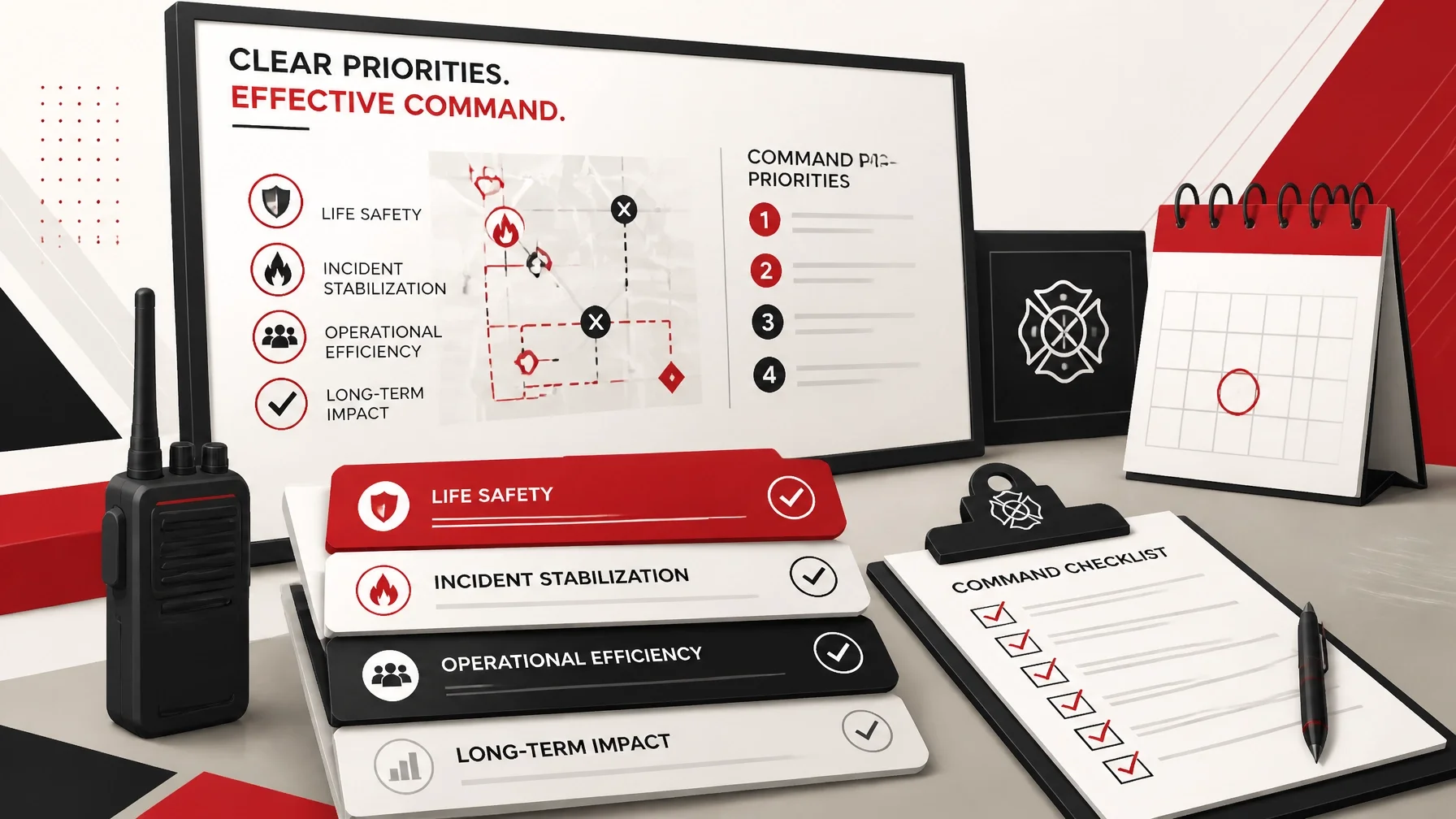
Use the Fires, Foundations, and Noise framework at the start of each shift or workday:
Review the mission: Identify the top operational and organizational priorities.
Empty your head: Capture every open task, concern, commitment, and decision.
Sort the list: Mark each item as Fire, Foundation, or Noise.
Choose your top three: Select no more than three outcomes that need your personal attention today.
Protect foundation time: Put at least one relationship, development, planning, or culture-building activity on your calendar.
Create an interruption plan: Tell your team what can interrupt you and what should wait.
Close the loop: Review what moved, what changed, and what carries into tomorrow.
Do not measure success only by how much you completed. Measure whether your attention went to what mattered most.
Lead the Right Fire
Your department does not need you to answer everything or solve every problem personally.
It needs you to create clarity.
When you separate fires from foundations and noise, you make better decisions. When you manage interruptions well, you stay accessible without becoming scattered. When you protect mental fitness, you lead from choice rather than reactivity. And when you follow through, you build trust that strengthens the whole organization.
The goal is not to put out every fire yourself.
The goal is to direct your command attention to the fire that matters most, while protecting the foundations that prevent the next one.
If your workload, leadership responsibilities, or team dynamics are pulling you in too many directions, contact me at www.mariancoaching.com. I can help you build a practical system for prioritization, emotional intelligence, mental fitness, and trusted command.
